AR Meter Download APK 2026 | Measuring Tape Camera For Android & IOS
September 17, 2026
100 MB
V4.0.8
Android 6.0+
1000+

Description
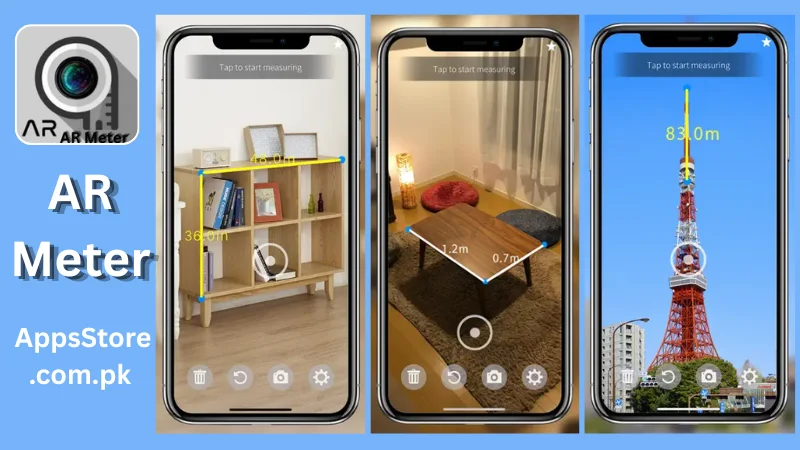
In an era dominated by smart automation, traditional manual measurement tools are rapidly becoming obsolete. Whether you are an architect conducting a quick site survey, an interior designer planning a layout, or a homeowner shopping for new furniture, relying on a physical tape measure can be cumbersome and inefficient. Enter the AR Meter app a cutting-edge mobile solution designed to transform your smartphone into a high-precision, pocket-sized digital ruler.
By leveraging advanced spatial algorithms and computer vision, this application allows users to measure distances, calculate surface areas, evaluate 3D volumes, and generate digital floor plans in seconds. This comprehensive article explores everything you need to know about this technology, its inner workings, practical applications, and how to maximize its accuracy.
What is the AR Meter App?
The AR Meter Tape is a mobile application powered by spatial computing and augmented reality (AR) that enables users to measure physical real-world objects using their smartphone’s camera. Instead of stretching physical tapes across rooms or struggling to measure high ceilings, you simply point your device’s lens at a target surface, set virtual anchor points, and let the software compute the exact dimensions instantly.
Serving as a versatile 3D measurement tool for Android and iPhone users, this application bridges the gap between hardware sensors and visual data, making spatial mapping accessible to anyone with a compatible mobile device.
Boost your digital experience by securing your connection with PandaVPN to bypass geo-restrictions and download any app smoothly. Enjoy fast, encrypted browsing while downloading all your favorite tools without any regional limitations.
How Augmented Reality Measurement Technology Works
To appreciate the capabilities of a camera measuring application, it helps to understand the underlying technology that powers it:
Simultaneous Localization and Mapping (SLAM)
SLAM algorithms process visual data from your camera feed to detect distinct feature points (such as floor textures, wall edges, or carpet patterns) in your surroundings.
Device Motion Tracking
The app combines input from your smartphone’s internal sensors specifically the gyroscope and accelerometer to track how far and in what direction your phone moves through space.
Depth Sensing & LiDAR Integration
On newer devices equipped with Time-of-Flight (ToF) sensors or LiDAR scanners, the software bounces light beams off physical objects to calculate precise distance down to the millimeter level.
Virtual Overlay Rendering
Once the physical environment is mapped, the interface draws dynamic virtual lines, angle markers, and numerical metrics directly onto your screen over the live video feed.
Key Features and Advanced Tools
Modern spatial measurement software goes far beyond basic line-to-line measurements. The AR Meter APK includes a robust suite of digital tools designed for diverse project needs:
Linear Distance Tracking: Measure point-to-point distances across straight lines, curved paths, or multi-segment trajectories.
Area and Perimeter Estimation: Outline dynamic polygons on floors, walls, or countertops to instantly compute total square footage or square meters.
3D Volume and Height Detection: Calculate the volumetric capacity of boxes, furniture items, or entire structural enclosures without needing manual ladders.
Angle and Level Indicators: Built-in digital protractors allow you to verify wall alignment, pitch angles, and structural inclinations effortlessly.
Multi-Unit System Compatibility: Effortlessly toggle between metric (millimeters, centimeters, meters) and imperial systems (inches, feet, yards) on the fly.
Project Documentation and Export: Save annotated photo snapshots with embedded dimensions, or export complete floor plan blueprints as digital files.
How to Download AR Meter APK
- Open App Store Launch the Google Play Store on Android or the Apple App Store on iOS.
- Search the App Type AR Meter in the search bar and select the official app from the list.
- Install Tap Install to download and setup the application on your smartphone.
- Grant Permissions Open the app and allow camera permissions so the AR sensors can begin measuring.
How to Measure Room with AR Meter Tape
Mapping out an entire residential or commercial space might seem complex, but the process is straightforward when executed systematically. Follow these steps to map your space accurately:
Download & Initial Calibration
Start by finding an AR Measure Camera app free download from the official Google Play Store or Apple App Store. Launch the app and grant the necessary permissions for camera access. Slowly sweep your smartphone side-to-side across the floor so the algorithm can detect surface planes and establish plane tracking.
Establish Base Anchor Points
Position your screen crosshair over the first corner of the room at floor level and tap the action button to set your starting anchor point. Walk along the perimeter of the room, tapping at each corner to set sequential points.
Outline Walls and Openings
Continue dropping anchor points along the baseboards until you return to your starting position. The system will auto-connect the points, closing the polygon to display total perimeter and floor area.
Measure Vertical Heights and Fixtures
Aim the camera toward the ceiling joint directly above your base point to record wall height. You can also drop anchor points around door frames and window openings to log architectural cutouts.
AR Meter App vs Traditional Tape Measure
Choosing between a digital augmented reality solution and classic manual measuring instruments depends on your specific workflow demands:
| Performance Metric | Traditional Tape Measure | AR Meter App |
| Operational Labor | Requires 2 people for long distances | Single-operator execution |
| Speed and Efficiency | Slow, physical placement and manual logs | Instantaneous digital generation |
| Reach and Accessibility | Limited by physical tape bending/flexing | Reaches high ceilings and wide spans easily |
| Data Retention | Manual note-taking on paper | Automatic digital history and photo tag exports |
| Measurement Accuracy | Exact millimeter precision (100%) | Near-exact estimation (95% – 98% accuracy) |
When comparing AR Measure Camera vs traditional tape measure, the software provides unparalleled speed and ease of use, making it ideal for quick estimates, site surveys, and preliminary planning.
Best Practices to Improve Digital Sensor Accuracy
While augmented reality algorithms are highly sophisticated, external factors in your environment can impact performance. Follow these optimization tips to achieve maximum accuracy:
- Ensure Ample Environmental Lighting: Camera sensors struggle in dim conditions. Always illuminate the room fully before starting your session.
- Target Textured Surfaces: Featureless, highly reflective surfaces like plain white walls or glass mirrors can confuse optical tracking. Placing a small object or tape mark on plain surfaces gives the camera a tracking anchor.
- Maintain Steady Device Motion: Move your smartphone smoothly without sudden, erratic movements to maintain continuous SLAM tracking.
- Keep Distances Moderate: For maximum accuracy, keep anchor points within 10–15 feet (3–5 meters) of your position rather than scanning far-off horizons in a single pass.
Pros and Cons
Pros:
- Eliminates the need to carry physical tapes, ladders, or laser measures.
- The AR Meter app user interface is intuitive and requires no technical background to operate.
- Accelerates site surveys and client estimates significantly.
- Offers instant unit conversion without manual math calculations.
Cons:
- Battery-intensive due to concurrent high-end camera, sensor, and GPU processing.
- Unsuitable for high-precision manufacturing or structural engineering requiring exact millimeter tolerance.
Practical Applications Across Various Industries
The versatility of the AR Meter app extends across numerous personal and professional fields:
Interior Design and Space Planning: Quickly capture room dimensions to select appropriately scaled furniture, rugs, and artwork.
Real Estate and Property Listing: Realtors can quickly draft approximate floor plans and capture room dimensions to showcase properties to prospective buyers.
Home Renovation and DIY: Determine material requirements such as paint coverage, flooring square footage, or baseboard trim lengths in minutes.
Logistics and Warehousing: Measure box dimensions and storage shelf volumes rapidly to optimize shipping loads and freight space.
Conclusion
Integrating the AR Meter app into your daily digital toolkit brings unprecedented convenience to spatial measurement. By combining smartphone camera technology with real-time augmented reality rendering, it streamlines complex measuring tasks into simple point-and-tap actions. Download the app today to simplify your planning and experience the future of digital spatial mapping.
For more tools and Apps visit: AppsStore
Frequently Asked Questions (FAQs)
Q1: Is the AR Meter app free to download?
Yes, an AR Meter app free download is available on major app platforms. Basic features are accessible for free, with optional pro upgrades for advanced export formats and unlimited cloud storage.
Q2: What device requirements are needed to run the software?
Your smartphone must support modern AR frameworks specifically Apple’s ARKit (iOS 11 or newer) or Google’s ARCore (Android 7.0 or newer).
Q3: Can this app replace commercial laser distance meters?
For preliminary estimates, DIY projects, and interior planning, yes. However, for formal structural engineering, architectural blueprints, or legal property boundary surveys, professional physical tools are still recommended.
What's new
AR Meter App: The Ultimate Comprehensive Guide to Modern Augmented Reality Measurement
In an era dominated by smart automation, traditional manual measurement tools are rapidly becoming obsolete. Whether you are an architect conducting a quick site survey, an interior designer planning a layout, or a homeowner shopping for new furniture, relying on a physical tape measure can be cumbersome and inefficient. Enter the AR Meter app a cutting-edge mobile solution designed to transform your smartphone into a high-precision, pocket-sized digital ruler.
By leveraging advanced spatial algorithms and computer vision, this application allows users to measure distances, calculate surface areas, evaluate 3D volumes, and generate digital floor plans in seconds. This comprehensive article explores everything you need to know about this technology, its inner workings, practical applications, and how to maximize its accuracy.
What is the AR Meter App?
The AR Meter app is a mobile application powered by spatial computing and augmented reality (AR) that enables users to measure physical real-world objects using their smartphone’s camera. Instead of stretching physical tapes across rooms or struggling to measure high ceilings, you simply point your device’s lens at a target surface, set virtual anchor points, and let the software compute the exact dimensions instantly.
Serving as a versatile 3D measurement tool for Android and iPhone users, this application bridges the gap between hardware sensors and visual data, making spatial mapping accessible to anyone with a compatible mobile device.
How Augmented Reality Measurement Technology Works
To appreciate the capabilities of a camera measuring application, it helps to understand the underlying technology that powers it:
Simultaneous Localization and Mapping (SLAM)
SLAM algorithms process visual data from your camera feed to detect distinct feature points (such as floor textures, wall edges, or carpet patterns) in your surroundings.
Device Motion Tracking
The app combines input from your smartphone’s internal sensors specifically the gyroscope and accelerometer to track how far and in what direction your phone moves through space.
Depth Sensing & LiDAR Integration
On newer devices equipped with Time-of-Flight (ToF) sensors or LiDAR scanners, the software bounces light beams off physical objects to calculate precise distance down to the millimeter level.
Virtual Overlay Rendering
Once the physical environment is mapped, the interface draws dynamic virtual lines, angle markers, and numerical metrics directly onto your screen over the live video feed.
Key Features and Advanced Tools
Modern spatial measurement software goes far beyond basic line-to-line measurements. The AR Meter app includes a robust suite of digital tools designed for diverse project needs:
Linear Distance Tracking: Measure point-to-point distances across straight lines, curved paths, or multi-segment trajectories.
Area and Perimeter Estimation: Outline dynamic polygons on floors, walls, or countertops to instantly compute total square footage or square meters.
3D Volume and Height Detection: Calculate the volumetric capacity of boxes, furniture items, or entire structural enclosures without needing manual ladders.
Angle and Level Indicators: Built-in digital protractors allow you to verify wall alignment, pitch angles, and structural inclinations effortlessly.
Multi-Unit System Compatibility: Effortlessly toggle between metric (millimeters, centimeters, meters) and imperial systems (inches, feet, yards) on the fly.
Project Documentation and Export: Save annotated photo snapshots with embedded dimensions, or export complete floor plan blueprints as digital files.
How to Measure Room with AR Meter App
Mapping out an entire residential or commercial space might seem complex, but the process is straightforward when executed systematically. Follow these steps to map your space accurately:
Download & Initial Calibration
Start by finding an AR Meter app free download from the official Google Play Store or Apple App Store. Launch the app and grant the necessary permissions for camera access. Slowly sweep your smartphone side-to-side across the floor so the algorithm can detect surface planes and establish plane tracking.
Establish Base Anchor Points
Position your screen crosshair over the first corner of the room at floor level and tap the action button to set your starting anchor point. Walk along the perimeter of the room, tapping at each corner to set sequential points.
Outline Walls and Openings
Continue dropping anchor points along the baseboards until you return to your starting position. The system will auto-connect the points, closing the polygon to display total perimeter and floor area.
Measure Vertical Heights and Fixtures
Aim the camera toward the ceiling joint directly above your base point to record wall height. You can also drop anchor points around door frames and window openings to log architectural cutouts.
In-Depth Comparison: AR Meter App vs Traditional Tape Measure
Choosing between a digital augmented reality solution and classic manual measuring instruments depends on your specific workflow demands:
| Performance Metric | Traditional Tape Measure | AR Meter App |
| Operational Labor | Requires 2 people for long distances | Single-operator execution |
| Speed and Efficiency | Slow, physical placement and manual logs | Instantaneous digital generation |
| Reach and Accessibility | Limited by physical tape bending/flexing | Reaches high ceilings and wide spans easily |
| Data Retention | Manual note-taking on paper | Automatic digital history and photo tag exports |
| Measurement Accuracy | Exact millimeter precision (100%) | Near-exact estimation (95% - 98% accuracy) |
When comparing AR Meter app vs traditional tape measure, the software provides unparalleled speed and ease of use, making it ideal for quick estimates, site surveys, and preliminary planning.
Best Practices to Improve Digital Sensor Accuracy
While augmented reality algorithms are highly sophisticated, external factors in your environment can impact performance. Follow these optimization tips to achieve maximum accuracy:
- Ensure Ample Environmental Lighting: Camera sensors struggle in dim conditions. Always illuminate the room fully before starting your session.
- Target Textured Surfaces: Featureless, highly reflective surfaces like plain white walls or glass mirrors can confuse optical tracking. Placing a small object or tape mark on plain surfaces gives the camera a tracking anchor.
- Maintain Steady Device Motion: Move your smartphone smoothly without sudden, erratic movements to maintain continuous SLAM tracking.
- Keep Distances Moderate: For maximum accuracy, keep anchor points within 10–15 feet (3–5 meters) of your position rather than scanning far-off horizons in a single pass.
Pros and Cons
Pros:
- Eliminates the need to carry physical tapes, ladders, or laser measures.
- The AR Meter app user interface is intuitive and requires no technical background to operate.
- Accelerates site surveys and client estimates significantly.
- Offers instant unit conversion without manual math calculations.
Cons:
- Battery-intensive due to concurrent high-end camera, sensor, and GPU processing.
- Unsuitable for high-precision manufacturing or structural engineering requiring exact millimeter tolerance.
Practical Applications Across Various Industries
The versatility of the AR Meter app extends across numerous personal and professional fields:
Interior Design and Space Planning: Quickly capture room dimensions to select appropriately scaled furniture, rugs, and artwork.
Real Estate and Property Listing: Realtors can quickly draft approximate floor plans and capture room dimensions to showcase properties to prospective buyers.
Home Renovation and DIY: Determine material requirements such as paint coverage, flooring square footage, or baseboard trim lengths in minutes.
Logistics and Warehousing: Measure box dimensions and storage shelf volumes rapidly to optimize shipping loads and freight space.
Conclusion
Integrating the AR Meter app into your daily digital toolkit brings unprecedented convenience to spatial measurement. By combining smartphone camera technology with real-time augmented reality rendering, it streamlines complex measuring tasks into simple point-and-tap actions. Download the app today to simplify your planning and experience the future of digital spatial mapping.
Frequently Asked Questions (FAQs)
Q1: Is the AR Meter app free to download?
Yes, an AR Meter app free download is available on major app platforms. Basic features are accessible for free, with optional pro upgrades for advanced export formats and unlimited cloud storage.
Q2: What device requirements are needed to run the software?
Your smartphone must support modern AR frameworks specifically Apple’s ARKit (iOS 11 or newer) or Google’s ARCore (Android 7.0 or newer).
Q3: Can this app replace commercial laser distance meters?
For preliminary estimates, DIY projects, and interior planning, yes. However, for formal structural engineering, architectural blueprints, or legal property boundary surveys, professional physical tools are still recommended.
Download links
How to install AR Meter Download APK 2026 | Measuring Tape Camera For Android & IOS APK?
1. Tap the downloaded AR Meter Download APK 2026 | Measuring Tape Camera For Android & IOS APK file.
2. Touch install.
3. Follow the steps on the screen.